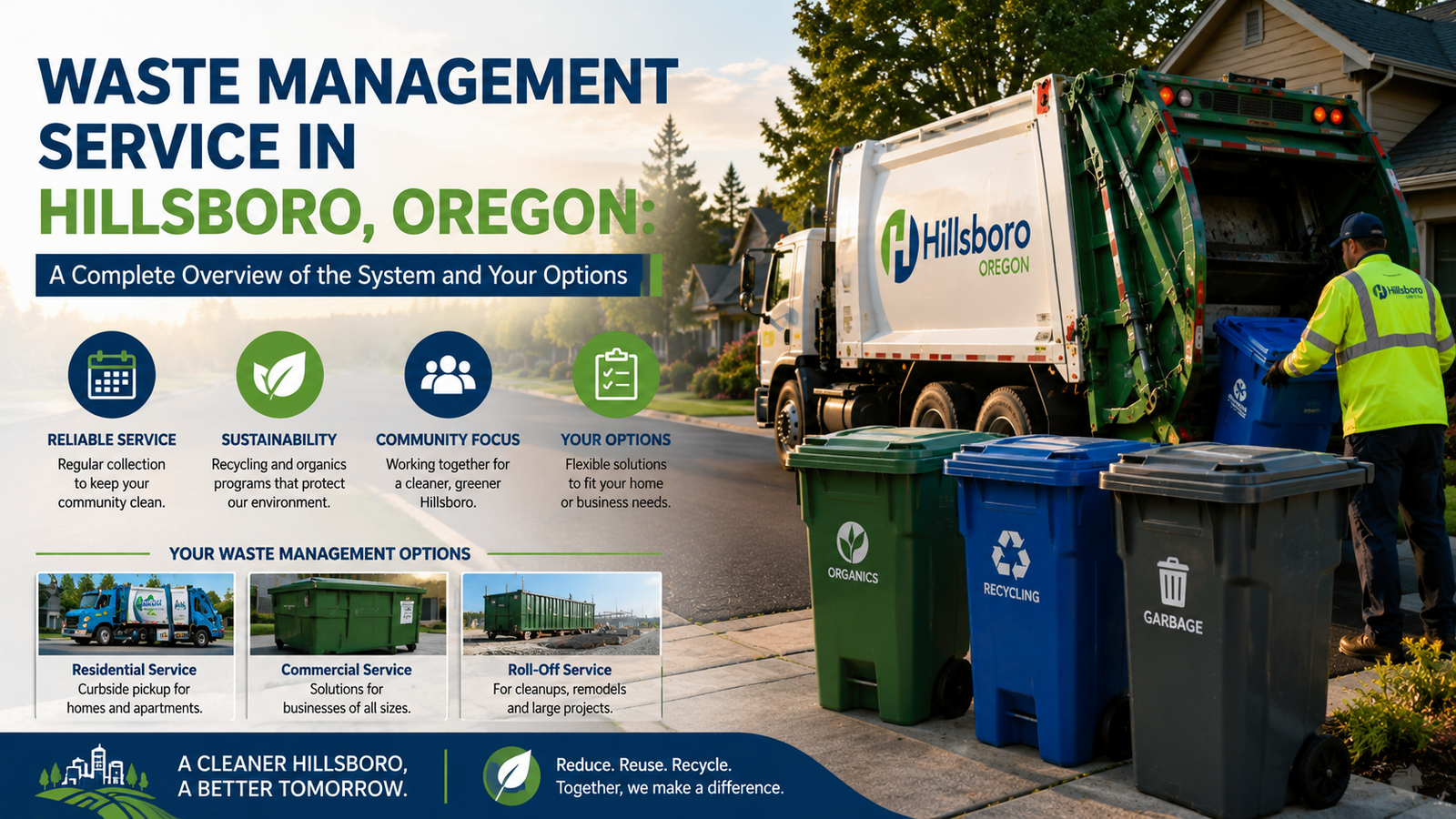
Effective waste management is one of the most important and yet most overlooked aspects of daily life in any community. In Hillsboro, Oregon, waste management is supported by a multi-layered system that combines the City’s franchised curbside collection program with Washington County’s regional solid waste infrastructure, Oregon Metro’s oversight and facilities, and the private sector services that address needs beyond what the public system provides. Understanding this complete Waste Management Service Hillsboro picture not just the curbside bins but the full ecosystem of services, facilities, and regulations helps Hillsboro residents and businesses manage their waste responsibly, minimize costs, and reduce their environmental footprint.
The Waste Management Hierarchy in Hillsboro
Oregon operates under a waste management hierarchy a prioritized framework for how waste should be handled, from most to least preferred. This hierarchy guides both public policy and individual behavior in Washington County communities including Hillsboro. Reduction and reuse are at the top of the hierarchy: the best way to manage waste is to not generate it in the first place, or to find productive uses for materials before they become waste. Recycling and composting come next: capturing material value from waste streams through processing and recovery. Energy recovery (converting waste to energy) comes before the least-preferred option of landfill disposal.
Oregon Metro, the elected regional government for the Portland metropolitan area, implements and oversees this hierarchy across Washington, Multnomah, and Clackamas Counties the three counties that make up the greater Portland area including Hillsboro. Metro operates regional facilities, sets regional policies, and provides the regulatory framework within which Hillsboro’s City-level waste management programs operate.
The Hillsboro Franchise Hauler System
The City of Hillsboro manages its primary waste collection infrastructure through a franchise hauler system established under Municipal Code section 6.08. Six private companies Hillsboro Garbage, Waste Management, Evergreen Disposal, Pride Disposal, Garbarino Disposal, and Walker Garbage Service hold franchise agreements that give them exclusive rights to provide curbside garbage and recycling collection within their designated service zones.
This franchise approach differs from both fully public municipal collection (where city employees handle all collection) and fully open-market collection (where customers choose from competing companies). The franchise model provides a middle path: private companies handle the day-to-day operation and capital investment in trucks and equipment, while the City establishes service standards, regulates rates, and ensures consistent access to collection service for all Hillsboro addresses.
Rates for franchise collection services are regulated and uniform across Hillsboro a resident in the North Hillsboro growth areas served by one hauler pays the same rate for equivalent service as a resident in the established East Main Street area served by a different hauler. This rate parity prevents geographic inequity in waste management access and cost.
Recycling Infrastructure in Hillsboro
Hillsboro’s recycling program is part of Washington County’s Cooperative Recycling Program, which includes Washington County and the cities of Banks, Durham, Forest Grove, Hillsboro, King City, North Plains, Sherwood, and Tualatin. This cooperative structure allows the participating jurisdictions to share education resources, program infrastructure, and program planning while maintaining local service delivery through the franchise hauler network.
Curbside recycling collection in Hillsboro accepts the core single-stream recyclables: paper, cardboard, metal cans, plastic bottles and containers, and glass. Items go into the blue recycling cart together and are sorted at a materials recovery facility (MRF) after collection. This single-stream approach maximizes participation by making recycling as easy as possible, though it requires that participants follow contamination guidelines to ensure that recovered materials meet market quality standards.
The Hillsboro Recycling Center operated by Pride Disposal at its facility offers drop-off recycling for materials that are not accepted in curbside carts. This includes styrofoam, electronics, batteries, and other specialty recyclables. Washington County’s network of over 200 drop-off locations accepts specialty materials including batteries, light bulbs, textiles, scrap metal, and other items that do not fit in standard curbside collection.
Organic Waste Management in Hillsboro
Organic waste diversion is one of the most significant components of Hillsboro’s waste management program. The city’s yard debris and food scraps collection service diverts substantial quantities of material from landfill to the composting facility in North Plains that processes Washington County’s collected organic waste into compost used in agriculture and landscaping applications.
Hillsboro was among the communities that expanded organic collection to include food scraps alongside yard debris a significant advance over programs that collected only yard waste. The combined yard debris and food scraps program accepts nearly all food-derived material: fruit and vegetable scraps, meat, seafood, dairy, grains, soiled paper, eggshells, and food-soiled cardboard. This broad acceptance makes it practical for Hillsboro households to divert the majority of their kitchen waste from the garbage cart.
Oregon has also established commercial food waste requirements that affect Hillsboro businesses. Food service establishments generating 250 pounds or more of food waste per week are required to separate food scraps for collection. Washington County provides technical assistance and resources to help Hillsboro food businesses comply with this requirement and set up effective food waste separation systems.
Transfer Stations and Disposal Facilities Serving Hillsboro
Hillsboro and Washington County residents who need to self-haul materials either because they exceed curbside capacity or because they are not accepted in curbside programs have access to Washington County’s transfer station and disposal infrastructure. The Tualatin Valley Waste Recovery Facility at the Hillsboro Landfill on SE Minter Bridge Road accepts residential and commercial solid waste, yard debris, and clean wood material from Washington County residents and businesses.
Metro’s household hazardous waste facility network serves Hillsboro residents needing to dispose of paints, chemicals, pesticides, batteries, fluorescent bulbs, and other hazardous household materials. The Metro Hotline at (503) 234-3000 provides information on disposal options, drop-off locations, and scheduled collection events for hazardous household materials across the greater Portland region.
When Standard Waste Management Services Are Not Enough
Hillsboro’s comprehensive franchise garbage collection and recycling program handles the routine, predictable waste generation of households and businesses with remarkable efficiency. However, the system has defined limits container sizes, material acceptance criteria, and scheduled service windows that do not accommodate every waste management need.
Estate cleanouts involve the removal of an entire household’s contents furniture, appliances, clothing, personal belongings, and accumulated material that represents decades of a person’s life. This scale of removal far exceeds what curbside carts can accommodate and requires the kind of full-property clearance that professional junk removal services provide. Renovation and construction projects generate debris concrete, lumber, drywall, flooring, tile that is explicitly excluded from residential curbside service. Property managers clearing rental units between tenants need rapid, thorough cleanout services that the scheduled franchise system cannot provide on demand. Business relocations and commercial cleanouts require the removal of equipment, furniture, filing systems, and accumulated commercial material that curbside commercial service is not designed for.
Private junk removal and debris removal services address all of these scenarios. They provide the on-demand, full-service, come-to-your-location removal capabilities that the scheduled, container-based public system is not designed to provide. In Hillsboro’s growing community, where estate transitions, home renovations, business changes, and rental property turnovers are everyday occurrences, these private services are an important complement to the public waste management infrastructure.
Frequently Asked Questions About Waste Management in Hillsboro
What is the Washington County Garbage and Recycling Day tool? It is an online resource at washingtoncountyor.gov/swr (and a free mobile app) that allows Hillsboro residents to enter their address and see their assigned franchise hauler, collection schedule, and information about what is accepted in each collection stream. It also identifies holiday schedule adjustments and weather-related service changes.
Does Hillsboro have a food waste composting program? Yes. Hillsboro’s yard debris collection service accepts food scraps in the same green cart as yard debris. The combined material is collected and composted at the facility in North Plains. Plastic bags cannot be used to contain food scraps food waste should go directly in the cart or in compostable paper bags.
What happens to materials that are improperly placed in recycling carts? Contaminated recycling loads carts with non-recyclable materials like plastic bags, food-soiled items placed without proper preparation, or prohibited materials may be rejected by the hauler with a non-collection notice. The hauler will leave a tag explaining what was wrong, and the resident typically has until the next collection day to correct the issue.
Where can I dispose of old paint in Hillsboro? Latex (water-based) paint in dried or empty cans can go in the garbage once fully dried leave the lid off to dry, or add kitty litter to speed drying. Oil-based paint and full paint cans must be taken to Metro’s household hazardous waste facility. PaintCare Oregon operates an active paint stewardship program with drop-off locations at participating retailers throughout Washington County.